What is RAID Data Recovery? A Comprehensive Guide to Principles and Practices
RAID data recovery is the specialized process of rebuilding data and restoring access from a failed RAID (Redundant Array of Independent Disks) configuration. This complex procedure goes beyond standard data recovery, requiring expert knowledge to reconstruct the unique architecture of multiple interconnected drives. When critical storage systems fail in business environments, understanding what is RAID data recovery becomes essential for maintaining data integrity and business continuity.
The Foundation: Understanding RAID Technology
RAID, which stands for Redundant Array of Independent Disks, is a data storage technology that combines multiple physical disk drives into a single logical unit for the purposes of data redundancy, performance improvement, or both. Originally named "Redundant Array of Inexpensive Disks" when first proposed by researchers at the University of California, Berkeley in 1987, the terminology was later updated to "Independent Disks" as the technology evolved.
RAID systems employ three fundamental techniques to achieve their objectives:
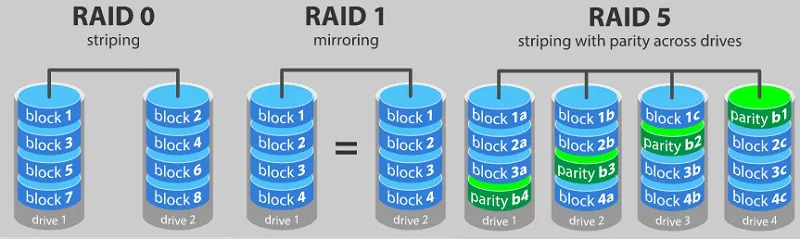
Data Striping: Splitting data evenly across multiple drives to improve performance
Disk Mirroring: Creating identical copies of data on multiple drives for redundancy
Parity: Using mathematical calculations (like XOR operations) to reconstruct data if a drive fails
These techniques form the building blocks for various RAID levels, each designed to address specific needs for data protection, performance, or a balance of both.
Common RAID Levels and Their Characteristics
Different RAID levels offer varying balances of performance, capacity, and data protection. Understanding these configurations is crucial when considering what is RAID data recovery for any specific setup.
Table: Comparison of Common RAID Levels
| RAID Level | Minimum Drives | Fault Tolerance | Key Characteristics | Typical Use Cases |
|---|---|---|---|---|
| RAID 0 | 2 | None | Data striping without redundancy; high performance | Video editing, temporary storage |
| RAID 1 | 2 | Single drive failure | Disk mirroring; complete data duplication | Critical file servers, small deployments |
| RAID 5 | 3 | Single drive failure | Block-level striping with distributed parity | File servers, web servers |
| RAID 6 | 4 | Two drive failures | Double distributed parity; enhanced protection | Data archiving, large storage arrays |
| RAID 10 | 4 | One drive per mirror | Combines mirroring and striping | Databases, high-performance applications |
Beyond these standard configurations, there are also distinctions in how RAID is implemented:
Hardware RAID: Uses dedicated RAID controllers and processing chips, offering high performance without consuming CPU resources
Software RAID: Implemented at the operating system level, more flexible but less efficient
JBOD (Just a Bunch of Disks): Not a true RAID level, but combines drives into a larger logical volume without redundancy
Common Causes of RAID Failures
RAID systems, while designed for reliability, can fail for various reasons. Understanding these failure scenarios is fundamental to grasping what is RAID data recovery in practical terms.
Physical Drive Failures
Physical damage to individual drives remains one of the most common causes of RAID failure. This includes:
Multiple simultaneous drive failures (exceeding the redundancy of the RAID level)
Bad sectors developing on one or more drives
Read/write head failures, motor issues, or electronic component failures
Controller and Configuration Issues
The RAID controller itself can be a point of failure:
RAID controller malfunctions or complete failure
Accidental reconfiguration of the RAID array
Corrupted RAID metadata that defines the array's parameters
Incorrect replacement of a failed drive -
System and Human Factors
Operational issues frequently contribute to RAID failures:
Power surges or outages during read/write operations
Accidental deletion of critical files or partitions
Failed rebuild processes that interrupt before completion
Multiple drive dropouts where drives temporarily disconnect then reconnect
The RAID Data Recovery Process: A Step-by-Step Explanation
Professional RAID data recovery follows a meticulous, structured approach to maximize the chances of successful data retrieval while preserving the integrity of the original data.
1. Initial Assessment and Drive Imaging
The recovery process begins with a thorough evaluation:
Diagnostic evaluation to determine the exact cause and extent of failure
Physical inspection of each drive for visible damage
Creation of sector-by-sector clones of each drive in the array using specialized tools
This cloning process is performed in read-only mode to prevent any changes to the original drives, preserving them in their exact state at the time of failure. All subsequent recovery work is performed on these clones rather than the original media.
2. RAID Parameter Reconstruction
This technical phase is crucial to understanding what is RAID data recovery at its most complex:
Identifying the RAID level (0, 1, 5, 6, 10, etc.)
Determining stripe size (the amount of data written to each drive before moving to the next)
Establishing drive order (the sequence of drives in the original array)
Identifying parity rotation (how parity data is distributed across drives)
Determining data direction (the pattern of data writing across drives)
For RAID 5 systems, this involves recognizing one of four possible structure types: left-symmetric, left-asymmetric, right-symmetric, or right-asymmetric.
3. Virtual RAID Reconstruction and Data Extraction
With the parameters identified, technicians proceed to:
Build a virtual RAID using specialized software that emulates the original array
Apply recovery algorithms to reconstruct missing or corrupted data using parity information-
Extract complete files from the reconstructed virtual array
This process may involve sophisticated techniques such as file signature scanning and file system structure repair when directory information is damaged or missing.
4. Data Verification and Return
The final stage focuses on delivering usable data:
Validation of recovered files to ensure integrity and completeness
Organization of recovered data in a logical structure for client review
Secure transfer of recovered data to new storage media
RAID 5 Data Recovery: A Technical Deep Dive
RAID 5 presents a particularly interesting case study in understanding what is RAID data recovery due to its widespread use and unique recovery considerations.
RAID 5 uses distributed parity with block-level striping, spreading both data and parity information across all drives in the array . The recovery process relies heavily on the mathematical foundation of RAID 5, primarily the XOR (exclusive OR) operation .

The XOR operation has a special property that makes it ideal for data recovery: if you have A XOR B = C, you can calculate any one value if you have the other two. In RAID 5 terms:
P = D1 XOR D2 XOR D3 (where P is parity and D1, D2, D3 are data blocks)
If one drive fails, its data can be reconstructed using:
D1 = D2 XOR D3 XOR P (and similarly for any missing block)
This mathematical foundation enables the reconstruction of data from a single failed drive in a RAID 5 array. However, the process becomes significantly more complex with multiple drive failures or when critical RAID parameters are unknown.
11111
When to discovered Professional RAID Data Recovery Services
While software solutions exist for simple RAID issues, professional intervention is recommended in these scenarios:
Multiple drive failures in any RAID configuration -
Physical damage to any drives in the array
Unknown RAID parameters that prevent reconstruction -
Failed rebuild attempts that have worsened the situation -
Controller failures where configuration is lost -
Professional recovery services offer specialized environments like Class 100 cleanrooms for physically damaged drives and access to specialized tools like PC-3000 systems that can often handle recoveries beyond the capability of consumer software.
Prevention: Minimizing the Need for RAID Data Recovery
Understanding what is RAID data recovery naturally leads to the question of how to prevent the need for it. These best practices can significantly reduce your risk:
Implement comprehensive backups following the 3-2-1 rule (3 copies, 2 media types, 1 offsite) -
Monitor drive health proactively using SMART tools and regular checks -
Perform regular consistency checks on your RAID array -
Maintain documentation of your RAID configuration and parameters -
Use enterprise-grade drives designed for RAID environments -
Implement uninterruptible power supplies to prevent corruption during outages -
The Future of RAID Data Recovery
As storage technologies evolve, so do recovery methodologies. Emerging trends include:
AI-assisted parameter detection to automate parts of the analysis process
Enhanced support for solid-state drives with specialized considerations for flash memory
Cloud-integrated recovery environments for distributed systems
Advanced error correction algorithms for increasingly complex RAID configurations -
Conclusion: The Critical Role of RAID Data Recovery Expertise
Understanding what is RAID data recovery reveals it as both an art and a science - a meticulous process that combines deep technical knowledge of storage systems with practical expertise in data reconstruction. In an era where data represents one of the most valuable business assets, the ability to recover from RAID failures becomes not just a technical concern but a business imperative.
Whether you're an IT manager responsible for critical company data or simply seeking to understand this complex field, recognizing the principles, processes, and limitations of RAID data recovery provides valuable insight into protecting one of today's most precious resources: digital information. By implementing robust prevention strategies and knowing when to engage professional services, organizations can significantly reduce their data vulnerability and ensure business continuity even in the face of serious storage system failures.